There's a version of a conference recap that reads like a press release. This isn't that.
The 2026 FANUC ASI Conference was genuinely worth attending — not because of the polished presentations or the networking dinners, but because the conversations happening in the hallways and between sessions reflected something real: this industry is in the middle of a significant shift, and the people closest to the work know it.
This year also marked 30 years of partnership between FANUC and the Authorized System Integrator community. Three decades is worth acknowledging. It's easy to take for granted the infrastructure of relationships, trust, and technical collaboration that makes large-scale automation deployment actually work. Events like this are a reminder of how much of this industry runs on exactly that.
FANUC Is Leaning Into AI — And That Signals Something Important
I'll be direct: I came in with measured expectations around the FANUC product announcements. I left with a different view. FANUC is putting serious effort into making it easier to implement AI-enabled solutions on their platform. For anyone still on the fence about whether physical AI has a permanent place in industrial automation, this should settle it. When a company with FANUC's scale and installed base makes that kind of platform investment, it's not a bet on a trend. It's an acknowledgment that the trend has already won.
That direction reinforces what we're hearing across the industry. Physical AI isn't a future-state conversation anymore. It's where the major players are allocating resources, and that alignment creates real momentum for the entire ecosystem.
The Theme Nobody Had to Force
Sometimes conference themes feel manufactured. This one didn't.
Physical AI came up repeatedly — not because it was on the agenda, but because practitioners kept arriving at it independently. The integrators deploying systems today and the technology vendors building the next layer of capability — they're all landing in the same place. If you want to scale automation faster, deploy more systems, and keep U.S.-based operations globally competitive, AI has to be foundational. Not a feature. Not a differentiator. The foundation.
That framing resonates with me because it's how we think about building at OSARO. Not AI for its own sake, but AI that reduces deployment timelines, increases flexibility, and delivers systems that adapt when business requirements change — which they always do.
The Economic Case Is Getting Easier to Make
Connor Lokar from ITR Economics and Alex Shikany from A3 both pointed to 2026 as a strong growth year for the industry. I won't rehash the macro data — they presented it better than I can summarize it. What I will say is that the combination of a favorable economic backdrop and accelerating technical capability is creating a window that operators and integrators should be taking seriously.
The ROI conversations I'm having with customers right now are different than they were two years ago. The math is getting easier. That's not a small thing.
Four Growers Deserved That Award
The Innovative System of the Year went to Four Growers for their AI-enabled vegetable harvesting system. Two things stood out to me.
First, AI is no longer a future-state conversation in automation. It's shipping. It's in production. It's winning awards for real-world performance, not theoretical capability.
Second — and this one stuck with me — the Four Growers team came out of a university ecosystem. Recent graduates taking a breakthrough concept all the way through commercialization and into the market. That's the kind of story the industry needs to tell more often and tell louder. We talk a lot about the talent pipeline problem in robotics and automation. Four Growers is evidence that the talent exists. The challenge is building the pathways for it to reach us.
The Panel That Set the Tone
The AI and the future of automation panel — Claude Dinsmore from FANUC America, Murali Gopalakrishna from NVIDIA, Stefan Neuser from Intrinsic, and Albane Dersy from Inbolt — was one of the better panel discussions I've seen at an industry event. That's a high bar to clear. Usually these things drift toward safe, rehearsed answers.
This one didn't. The conversation was direct about what actually matters: deployment speed, the ability to scale AI-enabled systems across facilities, and software-defined approaches that make automation genuinely adaptable rather than just marketed as such. The through-line across all four panelists was consistent — deploy faster, adapt more easily, keep customers competitive. That's the work. Everything else is commentary.
What I'm Taking Back
I leave most industry events with a handful of business cards and a vague sense of optimism. I left this one with a clearer picture of where the market is heading and a sharper view of where OSARO fits within it.
Physical AI is not a buzzword cycle we're riding. It's the direction the industry is moving, and the practitioners closest to the problem are the ones driving it there. That's an energizing thing to witness firsthand.
If you were at the conference and want to continue any of these conversations — around physical AI, integrator collaboration, or where the deployment landscape is heading in 2026 — I'm genuinely interested in that dialogue.
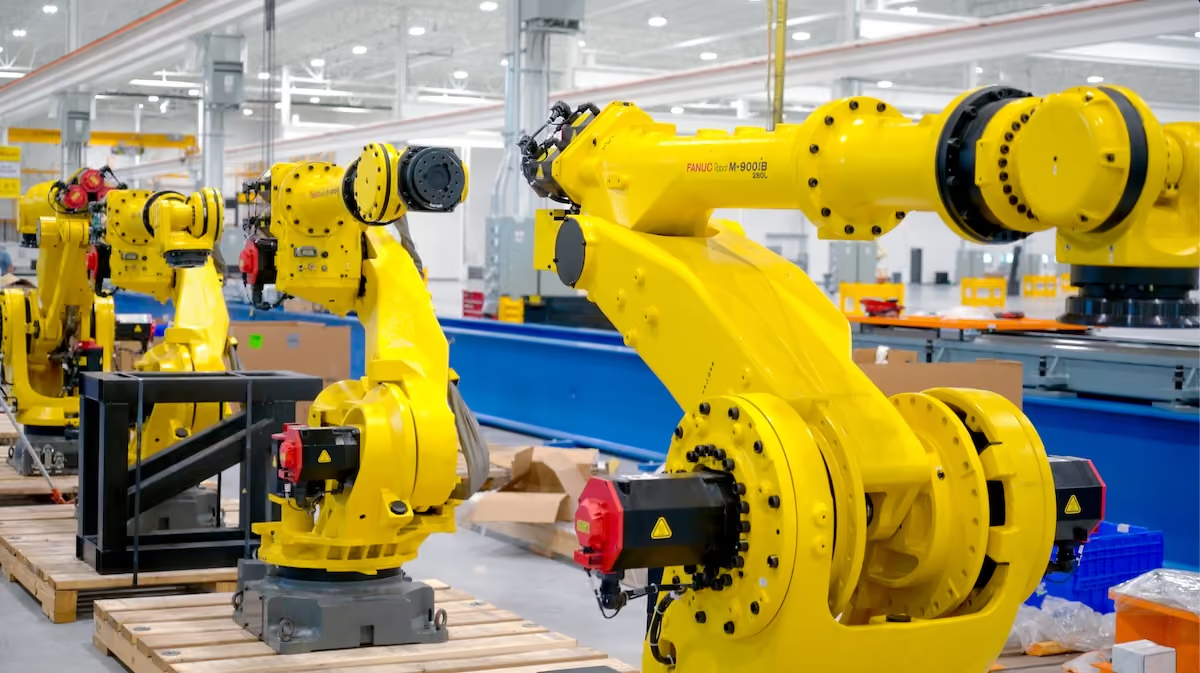
Photo credit: FANUC America Corporation