
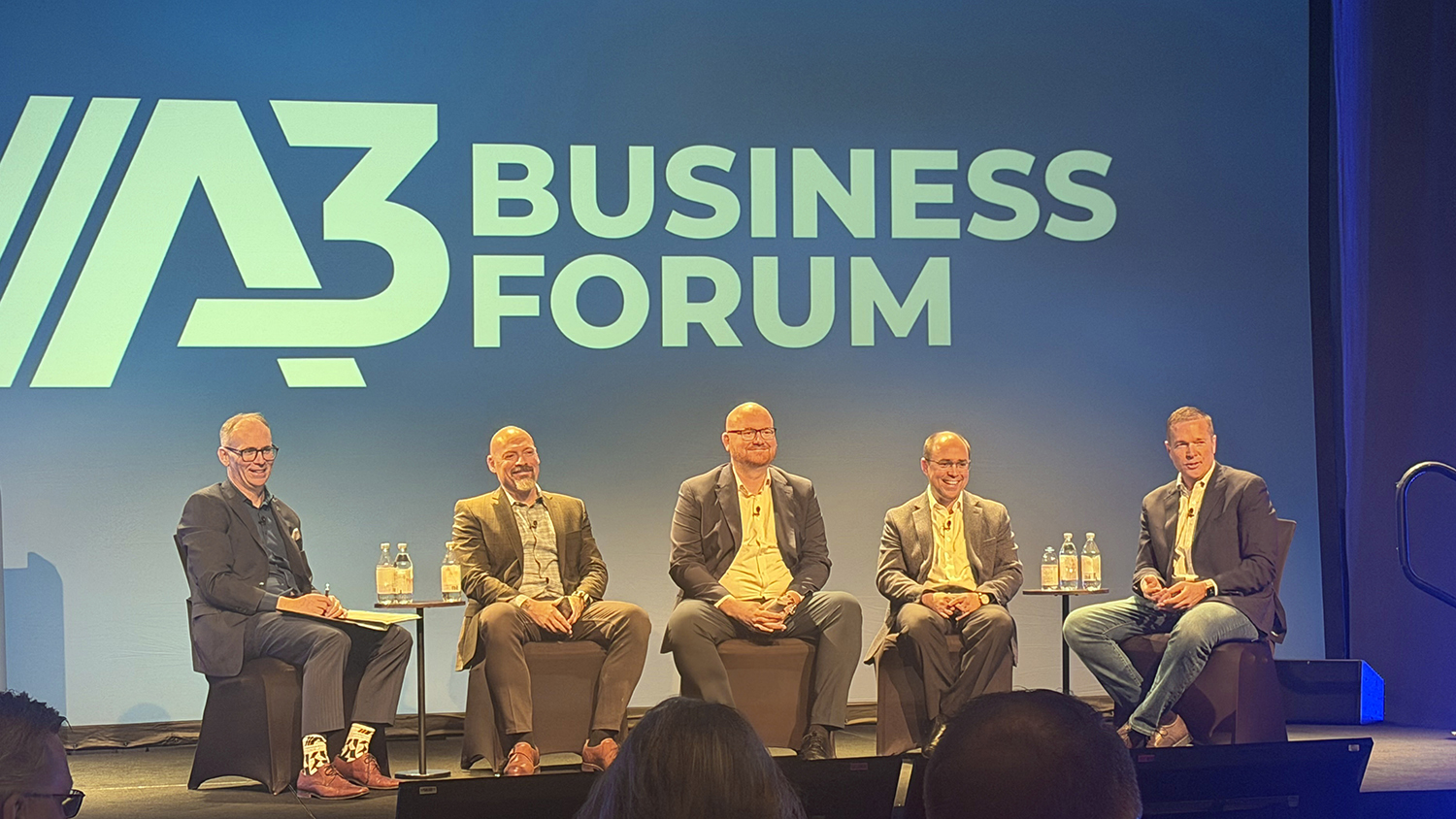
At the A3 Annual Business Forum, industry leaders came together for an Executive Roundtable on Technology, Trends, and What’s Ahead for 2026. The discussion tackled a familiar tension facing automation today: Unprecedented innovation paired with growing uncertainty about where to focus next.
The panel featured leaders representing automation hardware, vision, and software:
- Andre Marino, SVP, Industrial Automation North America Operations, Schneider Electric
- Gabe Zingaretti, Chief Operating Officer, OSARO
- Johannes Zurin, Chief Marketing Officer, Allied Vision
- Mike Cicco, President and CEO, FANUC America
The session was hosted by Robert Huschka, Vice President of Education Strategies at the Association for Advancing Automation (A3).
The state of automation: Innovation everywhere, focus required
When asked to characterize the state of automation heading into 2026, Gabe Zingaretti described an industry overflowing with innovation — and, at times, distraction. New technologies and concepts are constantly emerging, creating a cycle where organizations hesitate, waiting for the next solution instead of moving forward with what already works. We call this “puppy dog syndrome”.
Gabe emphasized that momentum matters more than perfection. “It’s better to start with a handful of units rather than not start at all,” he noted, reinforcing the idea that incremental deployment often delivers more value than waiting for a fully realized, large-scale rollout.
Despite ongoing economic uncertainty, shifting supply chains, and geopolitical pressure, customer priorities remain steady. Businesses still want to grow revenue, protect margins, and stay competitive. While tariffs, shipping costs, and pricing dynamics affect how investments are evaluated, they haven’t changed the fundamental need to act.
What’s actually working?
A key theme throughout the discussion was distinguishing production-ready technology from ideas that are still more aspirational.
Gabe pointed to meaningful progress where depalletizing, palletizing, and autonomous mobile robots (AMRs) converge. These solutions are already proving their value in live environments, improving throughput while enabling greater flexibility than traditional, conveyor-heavy systems.
On AI, Gabe framed its role in practical terms. Rather than positioning AI as a silver bullet, he highlighted its ability to handle variability where traditional automation struggles. “AI is helping us master the chaotic environment,” he said, referring to real-world conditions where products, packaging, and workflows are constantly changing.
His take was clear. Artificial Intelligence only matters when it improves performance under real operational complexity, not just in controlled demos.
Expanding the automation footprint
Looking ahead to 2026, Gabe highlighted an industry-wide opportunity to rethink how facilities are designed. Fixed, bolted-down infrastructure like conveyors can limit agility over time, while AMRs open the door to layouts that evolve with the business.
Rather than automating isolated tasks, the next phase of automation growth will come from flexible systems that can scale incrementally. Starting small, validating performance, and expanding over time allows organizations to manage risk while building confidence in automation outcomes.
This approach is also accelerating adoption among small and mid-sized manufacturers. While cultural resistance still exists, flexible deployment models and lower barriers to entry are helping more teams take the first step — even if it starts with just a few robots.
Let’s look forward: A realistic view of what’s next
When asked to predict the headline for automation in 2027, Gabe offered a grounded perspective: humanoids are still at least a decade away from meaningful industrial impact.
Rather than dramatic leaps, the coming years will be defined by disciplined execution. It’s necessary to apply proven technologies more intelligently, embracing incremental progress, and designing systems that can adapt as conditions change.
Why this conversation matters
The A3 Executive Roundtable reinforced a clear message: progress in automation isn’t about chasing every new idea. It’s about starting, learning, and building systems that work in the real world.
For OSARO, participating in conversations like this reflects a commitment to practical automation, highlighting solutions that learn in live environments, handle real-world variability, and deliver lasting value as operations evolve.
In 2026, the companies that succeed will be the ones that move forward with intention, not hesitation.