
"Flexible" might be the most overused word in warehouse automation. Nearly every picking system claims it, OSARO included. The word is easy to put on a homepage. What's hard is proving it once a system is standing in front of a live catalog that changes every week.
Flexibility is less a feature than a set of questions worth asking on every evaluation. A system either has good answers to them or it doesn't, and the difference shows up not in the demo but in month three, when the assortment has turned over and the easy SKUs are behind you.
Here is what matters.
Can it pick a product it has never seen?
This is the first and most revealing question. Many systems are flexible in theory but require data capture, model building, and retraining every time a new SKU shows up, and that work can take days or even weeks while the line sits idle. In e-commerce, new items arrive constantly. A system that treats every new product as a project will always be a step behind the catalog.
The better approach is perception that reads the scene directly rather than depending on a database of known items. OSARO's SightWorks™ builds a confidence map of the bin from RGB and 3D data and finds a grasp point without SKU-specific onboarding, so an unfamiliar item is handled much like a familiar one. The question to put to any vendor is simple: what exactly happens when a brand new SKU appears, and does the line have to come down for it?
Does the robot adapt its grasp to different products?
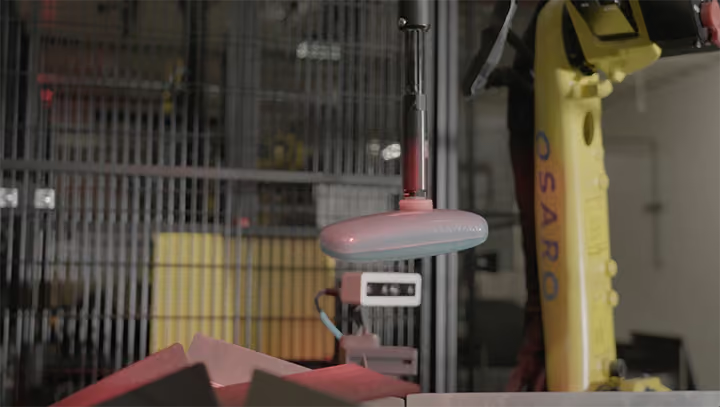
No single gripper handles apparel in poly bags, rigid boxes, bottles, and blister packs equally well. Real flexibility means deciding how to pick each item as it comes, not forcing every product through one fixed strategy. The systems that hold up account for object geometry, scene constraints, and gripper configuration, and select the right setup in real time based on what the station needs most, whether that's speed, precision, or first-pass yield. A system that grips everything the same way will always have a category of products it quietly fails on.
Does it hold up in a messy bin?
Demos use clean, well-spaced items. Real totes don't. Products overlap, lean against walls, and hide behind one another. A flexible system stays reliable when items are occluded and jumbled, because it identifies grasp points from the actual scene rather than needing a tidy, textbook view of each object. A system that only shines on staged bins isn't flexible. It's fragile.
What happens when a pick fails?
Every system eventually hits a case it can't complete cleanly: a drop, a double-pick, an item that won't release. Flexibility is as much about recovery as it is about the pick itself. If your models are not tuning themselves in realtime, improvement will be fundamentally more challenging/time consuming to achieve. Systems like these have more to learn from their failures than their successes - this is the only way to reduce exception cases. This is why we are fundamentally architected towards mission outcomes - it removes the guesswork. A system that stops and waits for a person on every exception erodes the labor savings that justified it. The stronger pattern is to treat exceptions as data. OSARO SightWorks tags outcomes like drops and misplacements through its sensor suite and feeds them back to refine the models, so the same failure grows rarer over time instead of becoming a permanent manual step.
Does it get better, or just stay the same?
A truly flexible system adapts as an operation changes. New products, new workflows, and seasonal swings shouldn't reset it to zero. AutoModel™, the learning engine inside OSARO SightWorks, is built to let robots adapt to new items and processes with zero downtime, which is what keeps a deployment scaling with the catalog rather than falling behind it.
The real takeaway
Flexibility isn't a checkbox, and it isn't the pick rate on a curated bin. It's whether a system can absorb the everyday chaos of e-commerce inventory: unfamiliar items, awkward items, crowded bins, and the exceptions that show up every shift, all without anyone stepping in.
So when a vendor calls its system flexible, the word shouldn't be taken at face value. Ask the five questions above, and watch how specific the answers get. The specificity is the signal.
Curious how a system would handle your hardest SKUs? That's the conversation worth having. Send us the products you think can't be picked, and we'll show you otherwise.